Expediting onboarding
Registration had to be strict, for safety. The job was making it feel clear and fair, moving people through it quickly, and turning its hurdles into reasons to trust the platform.
At a glance
- Situation
- New support workers took anywhere from under a week to over a month to be approved, and approval speed was capping Hireup's growth.
- Task
- Find and rank the bottlenecks in a registration process that had to stay rigorous for safety, security and privacy.
- Action
- Compared fast and slow applicants, analysed why applications were rejected, then redesigned the approvals queue with the team and registration as an up-front checklist with help where errors happened.
- Result
- A clearer path for applicants new to the sector, an approvals queue organised by stage, and the case for automating document collection.
Some approved in a week, some in six
Safety and security are the heart of a platform where strangers come into people's homes. Registration couldn't be a single email address: it had real-world requirements and a hands-on review by an in-house team. As applications grew, approval speed became the limit on how fast Hireup could grow. Some applicants were approved within a week; others waited a month or more.
Find the worst bottlenecks, without lowering the bar
Work out where applicants stalled and why, rank the causes, and speed things up without weakening the checks that kept clients safe.
Compare the fast with the slow
Who suffers most from a slow approval
Delays hurt everyone, but most of all a client and worker who already knew each other and applied separately. The client waited without support until their worker was through.
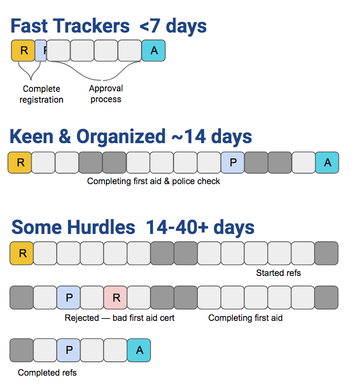
What the fast applicants had in common
Records showed a group who sailed through. Interviews and comparisons with slower applicants showed why: experience in disability or a related sector. They had their paperwork ready and knew what the work involved. Newcomers were less sure what work they qualified for and where to get certificates, and were uneasy about police checks. Across every group, confidence and clear communication predicted a smooth approval.
Why applications bounced
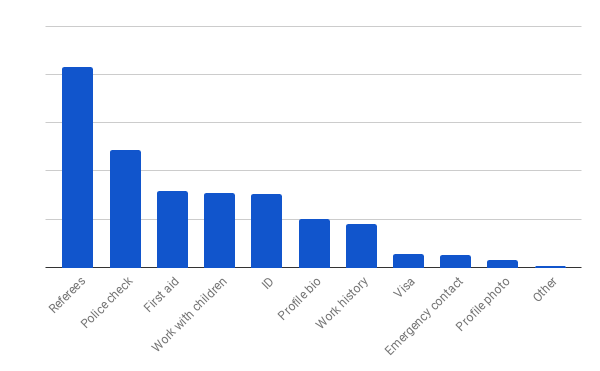
A provisionally rejected application went back to the bottom of the queue, which added the biggest delays of all. Four of the top five reasons were about documents: the wrong kind of certificate, or one that had expired. The registration form couldn't catch any of them, so they waited for a person to spot them.
Fix the queue, then the form
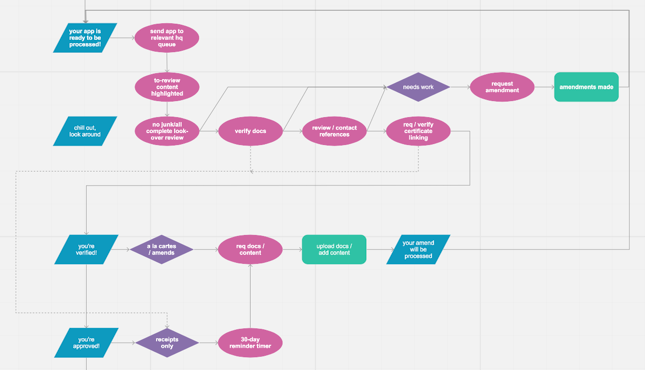
With the approvals team, I reorganised the queue by stage, to cut double-handling and soften the reject-and-resubmit loop. We trialled it by hand first, and that shaped the admin tools for a permanent process. Then I redesigned registration: requirements up front as a checklist, help in context exactly where people tended to make mistakes, and stories from workers with non-traditional backgrounds to build newcomers' confidence. Getting the right document the first time became its own project.
A clearer path in, and a gentler queue
- Up frontrequirements, so newcomers knew what they needed before they started.
- By stageapprovals queue, with less double-handling and a gentler resubmission loop.
- Less timefor our team spent on half-finished applications: applicants with complex requirements could see them up front and start when they were ready.
- Nextautomating document collection, the biggest single cause of delay.